
Academic Integrity for the AI Era
Beyond Plagiarism Detection
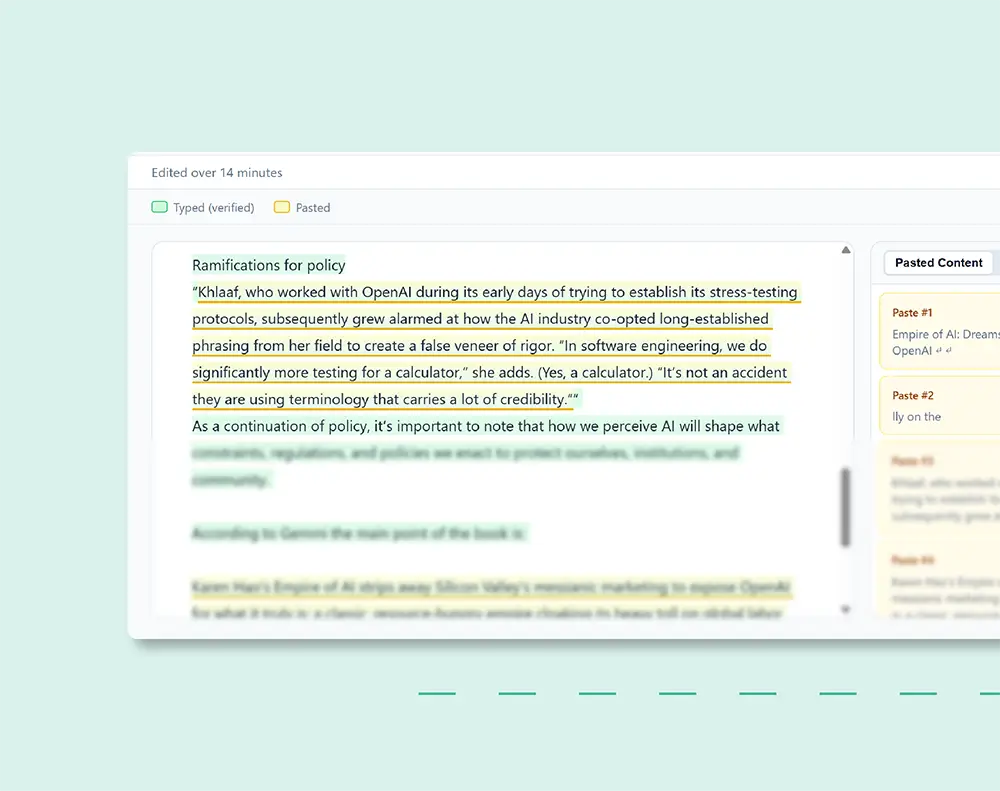
Add transparency to the writing process for students, instructors, and institutions alike, validating authentic work, promoting academic integrity, and avoiding false accusations of plagiarism.
Watch this video to get an introduction to Cursive
Already in use at 100+ global institutions
“Cursive has been an extremely valuable addition to our assessment ecosystem at Murdoch. […] Academics consistently reported that Cursive gave them far greater confidence that students’ writing was genuinely their own. Cursive also sent a strong signal to students that academic integrity was being actively monitored, and academic staff felt it directly deterred attempts to misuse AI.”
Interested in learning more?
FAQ
Questions, answered.
Authorship verification software confirms who wrote a piece of text by analyzing the writing process itself, keystroke patterns, revision history, and time on task, rather than scanning the finished document for signs of AI or plagiarism. Cursive is built specifically for this: it verifies effort and authorship as students write, giving institutions proof of the process rather than a probability score.
You can’t reliably prove AI use by scanning finished text, since AI classifiers only estimate a probability and are frequently wrong. Cursive instead verifies the writing process as it happens, capturing typing behavior, edit history, and time on task to show proof of effort, whatever tools a student used along the way.
AI detection analyzes a completed document and guesses whether AI generated it, a probabilistic process that’s prone to false positives and blind to editing done after a student drafts with AI. Authorship verification tracks the writing process directly, drafting, revising, and pacing, so it confirms who did the work regardless of which tools were involved.
Research has repeatedly found that AI text classifiers infer authorship from writing style, which disproportionately flags non-native English speakers and other groups of writers, alongside high false-positive rates. Cursive avoids this bias vector by evaluating the process behind a piece of writing rather than the style of the finished text.
Yes. Cursive works across every major LMS, including Blackboard, Canvas, Moodle, and D2L Brightspace, plus directly in a browser for writing done in Word or Google Docs. Native integration with Blackboard LMS is on the roadmap; today, it connects via a lightweight browser extension.
No. Cursive’s verification processing occurs on the student’s device rather than centralizing writing data in the cloud, resulting in a process record for an instructor to review, not an automated decision. That keeps student data local and keeps a human in control of every judgment call.
Common anti-plagiarism detection technologies work by checking the similarities between a student’s final submission and other known texts, such as academic journals and information online. Some of these have been expanded in recent years to include an algorithmic approach to estimate the likelihood that the student’s work was written by AI, however this has proved inaccurate and resulted in false accusations of plagiarism.
Cursive by Blackboard takes a new approach to academic integrity. It is focused on verifying authorship, using thousands of biometric signals to understand each writer’s unique style and then analyzing the writing process to confirm authenticity. It provides full transparency to the student, incentivizing authentic work and ensuring that they’re never in the dark on how academic integrity is assessed.